
What Turnkey PCB Assembly Actually Includes
- Key Takeaways
- What a turnkey PCB assembly quote covers
- Full turnkey, partial turnkey or consigned: who buys what
- What the turnkey quote usually doesn't include
- What stays your liability under full turnkey
- How does the assembler source your BOM?
- What does "tested" mean on a PCBA quote?
- Where turnkey PCB assembly ends and box build begins
- Does turnkey assembly change your country of origin?
- What to put in the RFQ
- FAQ
Turnkey PCB assembly is a contract manufacturing arrangement where the manufacturer handles all the procurement and production for printed circuit boards. The client supplies a design package that includes Gerber files, bill of materials (BOM), pick-and-place data, and assembly notes. The manufacturer is then responsible for sourcing the materials, assembling the circuit boards, inspecting them, and then shipping the finished product to the client.
Every supplier agrees on that definition. Where they stop agreeing is scope. Two quotes both labelled full turnkey can land thousands of dollars apart on the same BOM, because one covers the stencil, the first-article build, and the test fixture, and the other quotes those after you have committed. Turnkey tells you who buys the parts. It does not tell you how far the build goes.
So the question worth asking is not what turnkey PCB assembly means. It is which line items sit inside the number you were quoted, and which ones are still yours.
Key Takeaways
Turnkey PCB assembly is a type of contract manufacturing where the supplier is responsible for sourcing materials and production for printed circuit boards.
With partial turnkey PCB assembly, the client sources some of the materials themselves.
Where the PCB is assembled can affect the product’s official country of origin, not just where the components are sourced.
Although it’s framed as a comprehensive service, turnkey PCB assembly does not typically include any work related to the enclosure, cable harnesses, product labeling, or final assembly.
Table of Contents
- Key Takeaways
- What a turnkey PCB assembly quote covers
- Full turnkey, partial turnkey or consigned: who buys what
- What the turnkey quote usually doesn't include
- What stays your liability under full turnkey
- How does the assembler source your BOM?
- What does "tested" mean on a PCBA quote?
- Where turnkey PCB assembly ends and box build begins
- Does turnkey assembly change your country of origin?
- What to put in the RFQ
- FAQs
What a Turnkey PCB Assembly Quote Covers
| Stage | What the supplier does | Included in the base quote? |
|---|---|---|
| Design data review | Checks Gerber files, BOM, and centroid data for buildability and flags DFM issues | Usually, free at RFQ |
| BOM scrub | Prices every line, flags EOL and single-source parts, proposes crosses | Yes |
| Bare board fabrication | Builds to your stackup in-house or through a managed fabrication partner | Yes |
| Component procurement | Buys all BOM lines, including overage | Yes |
| Incoming inspection and kitting | IQC, moisture-sensitive device handling, ESD control, reel prep | Yes |
| SMT | Stencil printing, pick and place, reflow | Yes |
| Through-hole | Wave, selective or hand soldering | Yes |
| Inspection | Visual and AOI as standard, X-ray where there are BGAs or bottom-terminated parts | Base level varies |
| Electrical test | Anything from continuity to full functional test | Varies, often quoted separately |
| Finishing | Depaneling, cleaning, conformal coating, potting, serialisation | Usually separate |
| Packing and export documentation | Anti-static packing, labeling, commercial invoice, certificate of conformance | Yes |
Full Turnkey vs. Partial Turnkey vs. Consigned
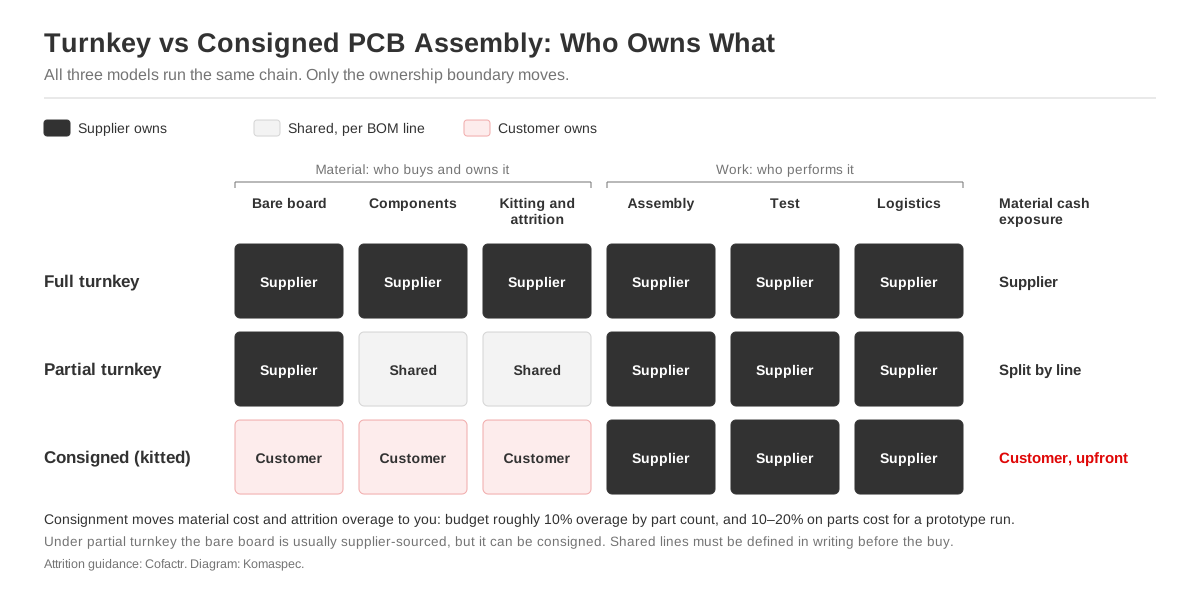
These three manufacturing models differ based on who supplies the materials needed for the assembly.
| Model | Components | Bare board | Material cash exposure | Best fit |
|---|---|---|---|---|
| Full turnkey | Supplier buys 100% of the BOM | Supplier | Supplier (recovered in unit price) | Most SMEs and startups without a procurement function |
| Partial turnkey | You supply named lines, supplier buys the rest | Usually the supplier | Split by line | Franchise pricing on specific parts, programmed or proprietary devices |
| Consigned (kitted) | You buy and ship a complete kit | You | You (upfront) | Established procurement teams with locked AVLs and existing stock |
Full turnkey assembly is the right choice for most SME hardware programs, because the supplier (not the client) is liable for any issues with the materials or components. Let’s say a board fails because of a bad capacitor, the supplier will be the one responsible for replacing it. Under consignment, you supply the part and the assembler only guarantees their workmanship. So when a component fails, it can turn into an argument about which party is responsible for fixing the problem.
Partial turnkey assembly should only be an exception for certain lines on your BOM. It should not be the blanket model for the entire build. For example, you might choose to consign the FPGA you have a franchise agreement on or the microcontroller you pre-programmed. But consigning 400 passives to save on the markup could be a false economy if you end up spending more resources managing the kit than you save by outsourcing the assembly.
With consignment, you also take on all the costs related to attrition. Your assembler will end up consuming extra parts because of feeder leaders, mispicks, and rework. They’ll require some amount of overage to cover it. Cofactr puts the typical overage at around 10% of the part count listed on the BOM, with 10 to 20% added to parts cost on a prototype spin. So this can be a substantial amount. Small passives run even higher than that, while ICs and connectors run lower. But no matter what, if you only kit the exact quantities needed to put together each unit, the assembler will run out of parts before reaching the unit count you requested.
What the Turnkey Quote Does Not Include
The full expense of outsourcing to an assembler doesn’t always show up in the quote, because some line items are typically left off.
None of these costs are hidden, per se. But they usually won’t be listed in the price unless you specifically ask for them to be included.
Non-Recurring Engineering
At higher volumes, suppliers may absorb the non-recurring engineering (NRE) costs (e.g., stencils, programming, panel tooling, first-article build). But with a prototype or small order, these are more likely to be itemized as part of the quote.
Testing Procedures and Custom Fixtures
Running in-circuit testing requires a custom-built bed-of-nails fixture. This can be a fairly substantial expense. FixturFab puts the figure at $2,000 to $10,000+, depending on the complexity of the board.
Firmware and Programming
This includes loading images, provisioning keys, and end-of-line calibration. Each of these are labor steps that require a procedure and a golden unit.
Safety Certification
A supplier can help by building the boards according to the right standard or by providing you with submission support. But you’ll be ultimately responsible for the lab fees, sample builds, and the file. If you're considering UL, ETL, and CSA certification, budget that expense separately from the PCB assembly.
Post-Assembly Work
The steps that come after the board is built (e.g., enclosure tooling, cable harnesses, packaging design, and final assembly) are not typically included in the quote. Add these to the request for quotation (RFQ) as separate line items. That way, the supplier will have to either price them or write “N/A” so you’ll know exactly what will be included and what won’t.
What Is Still Your Liability Under a Full Turnkey Agreement?
Even with a turnkey arrangement, some decisions and responsibilities still fall in your court:
Approved Vendor List and Alternates
In the event of shortages, you will have the final say on which alternatives are acceptable. If your supplier has to wait for you to approve a new vendor or alternate parts, this can stretch out your timeline. To prevent this, specify which manufacturers are acceptable for each component ahead of production.
NCNR and MOQ Commitments
Some parts will have reel minimums, meaning you need to order a certain amount even if it exceeds what you actually need for your build. These minimums are considered non-cancellable and non-returnable (NCNR) lines and will get committed on your behalf. So ask whether these costs are included in the quoted unit price or if they will be added as a separate charge.
Excess and Obsolete Materials
Who owns and stores the extra materials left over at the end of production? Agree to this up front and specify what happens if the product is discontinued.
Engineering Changes
Changing your drawing is cheap at the design stage, but that changes once the materials have already been committed. If you issue an engineering change order (ECO) at that point, you’ll have to foot the cost for the inconvenience and the materials that were ordered but are no longer needed.
Production Volume
The pricing you get from a turnkey assembler is usually based on an assumed volume. If your production run is smaller than the supplier anticipated, your pricing will go up accordingly.
We recommend writing “no substitution of any BOM line without written approval” on your purchase order. This one sentence can help prevent the most common turnkey failures.
How Does the Assembler Source Your BOM?
Material Sourcing
Check whether your supplier sources materials through authorized distribution channels. It means the part came through a channel with a formal agreement with the component manufacturer. This comes with traceability and warranty. Otherwise, assume the material was sourced from the grey market or through a broker, and it won’t carry the same guarantees.
In a June 2026 position paper, the ECIA advised against procuring components from the grey market, especially for safety-critical applications.
A turnkey supplier should be able to tell you how they procured every material they use for your build. If they can’t, assume it’s not authorized distribution.
Material Availability
Availability is the other thing to consider, and it’s becoming tighter.
According to IBS Market Intelligence, in July 2026 the distribution inventory across 15 component categories dropped to 18% below their May 2025 levels. The average lead time for components also rose from 16.7 weeks in February 2026 to 20.6 weeks just a few months later, with semiconductors averaging 26.8 weeks. In total, 11 of the 15 categories were above the 12-week planning target.
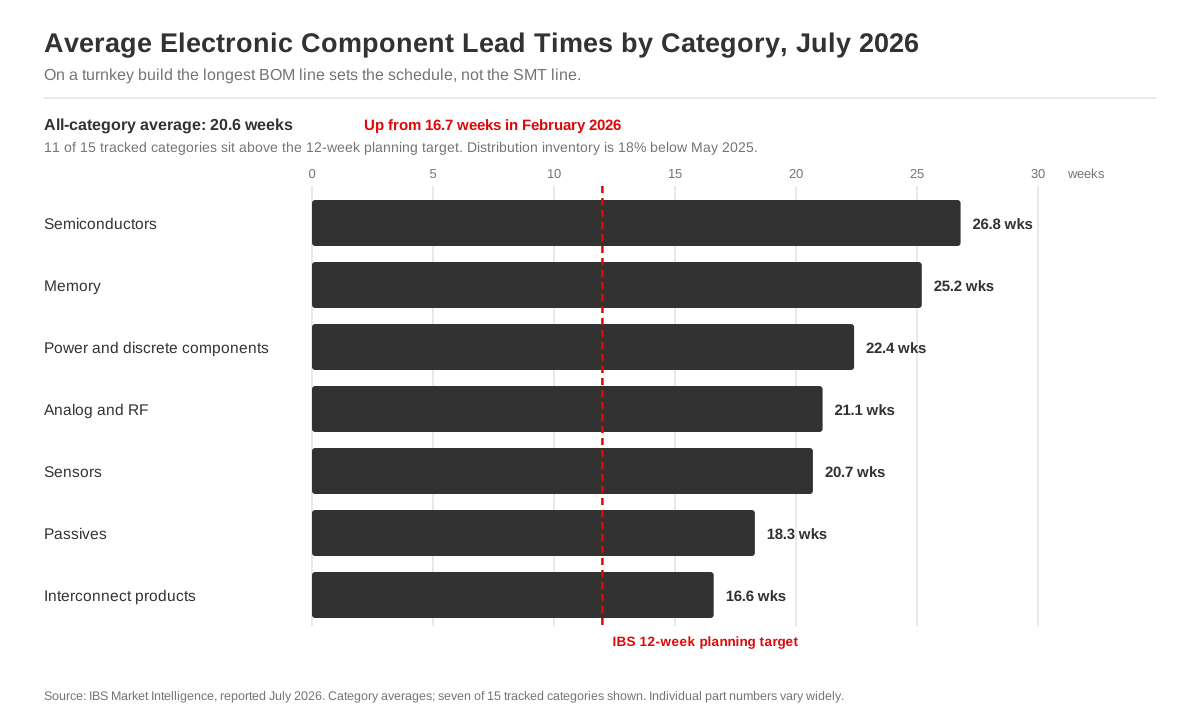
The boards you ordered can only be shipped out to you after the assembler has received every single item on the BOM. So if your build includes a microcontroller with a long lead time, your PCBs can’t be assembled until that component arrives. This alone can set your entire schedule back, even if the assembler has a fast SMT line.
To minimize delays, give the assembler a list of pre-approved alternatives while you’re still at the RFQ stage. That way, you won’t have to scramble to get this done once a shortage hits. Treat any line item that comes back no-quote as a design decision you have to make.
What Does "Tested" Mean on a PCBA Quote?
On a PCB assembly quote, “tested” can refer to one of five testing methods:
| Testing method | Catches | Doesn't catch | Typical application |
|---|---|---|---|
| Automated optical inspection (AOI) | Missing, skewed, tombstoned, or wrong-polarity parts, solder defects | Hidden joints, wrong component value | Every SMT build |
| X-ray | Voiding and opens under BGAs, QFNs, bottom-terminated parts | Functional faults | Boards with hidden joints |
| Flying probe | Shorts, opens, wrong values | System behavior | Prototypes, low volume, frequent revisions |
| In-circuit test | Same as flying probe, but far faster per board | System behavior | Stable designs at volume |
| Functional test | Whether the board does its job | Latent defects with no functional signature | Anything shipping to an end user |
According to SPEA, the choice of test comes down to volume and stability: bed-of-nails fixtures suit mature designs at high volume, while flying probe testing is better suited for lower volumes and assemblies with frequent design changes. For most SME hardware, the testing method is a flying probe test (or no test) at the board level, with a functional test at the product level.
The acceptance class also determines which tests will be needed. The IPC-A-610 standard categorizes electronic assemblies into three classes:
Class 1 for general electronics where the product is mainly expected to function as intended.
Class 2 for dedicated service products that are expected to have extended life, but can fail occasionally without serious consequences (most industrial and commercial equipment falls under this class).
Class 3 for high-performance products where downtime can't be tolerated (Class 3 assemblies are costlier because they involve more inspection time and result in more scrap).
Name the acceptance class and the required testing in your RFQ. Otherwise, you’ll just end up with whatever the supplier’s default happens to be. Usually, it’s a Class 2 visual inspection plus AOI testing, but you won’t discover any testing gaps until a field return.
What Is the Difference Between Turnkey PCB Assembly and Box Build?
With a box build assembly, your supplier will handle more steps in the production. But with turnkey PCB assembly, you’ll need multiple vendors to complete your product unless you’re just commissioning a bare PCBA.
How different are these two manufacturing models? The best way to answer that is to count every step that still need to be done after you receive the boards. Obviously, there’s the enclosure and its tooling, cable harnesses, connectors, fasteners, and off-the-shelf hardware. Then the displays, seals, labels, and final assembly. Finally, product-level functional testing, certification samples, and packaging. Every single one of those steps might need to be outsourced to its own supplier, who each have their own individual lead times and quality systems.

Komaspec's project work follows this same box build pattern. For instance, we build mining IoT devices that integrate PCBAs, custom cables, and connectors into overmolded plastic housings that are rated to IPX7. The housing, cabling, and final assembly all run under one program, with the PCBA managed through our supply base.
A box build for an electromechanical product will include the PCBA as part of the overall program, so you won’t need a separate supplier to assemble it. And at the end of the day, if you're working with a turnkey supplier but are still managing five different vendors, you haven’t actually managed to consolidated your production.
Does Turnkey Assembly Change Your Country of Origin?
Sometimes. And this could be a bigger factor than it used to be.
US Customs and Border Protection (CBP) has ruled that populating and testing a PCBA can count as substantially transforming its components. So where the components were assembled could matter more than where they were sourced from. In their N324628 ruling, they found that components originating from China, including an LCD display, were substantially transformed by the PCBA manufacturing performed in Mexico.
The Office of the United States Trade Representative (USTR) extended 178 Section 301 exclusions on goods originating from China, but only until November 10, 2026. So if your PCBA is built is China and currently exempt, you should assume that the duty will be back in force by 2027.
There’s a chance the country where your PCB is built becomes its official country of origin. That’s why you should select your build location at the design stage. It’s also one of the benefits of working with a supplier that can build in more than one country.
For example, Komaspec operates six facilities across Guangzhou, Haiphong, and Ciudad Juárez. That gives us the flexibility to quote the same project against different tariff and transit profiles. This gives you a clear picture of the trade-offs of choosing to manufacture in China versus Vietnam and why it’s not just about picking the country with the cheapest labor.
But remember that the product’s origins are fact-specific, so confirm any real exposure with a customs broker or a binding CBP ruling rather than relying on the supplier's advice and assurances.
What to Put in the RFQ
Ask every supplier to price (or explicitly decline) each of these items:
- The sourcing model used for each BOM line (turnkey, consigned, or partial).
- Which sourcing channel was used for each line, with traceability documentation.
- Non-recurring engineering costs (NRE), broken out into separate line items (i.e., stencil, programming, panel tooling, first article).
- The IPC-A-610 acceptance class.
- The testing scope (e.g., AOI, X-ray coverage), electrical test method, and who will be writing the functional test spec.
- The attrition and overage rules by package size.
- NCNR and MOQ exposures, and who owns the excess material at end of life.
- A written substitution policy.
- Country of origin and the HTS classification the supplier will declare.
The responses you get to these questions will vary, but any good supplier will provide you clear answers without hedging. Be wary of any vendor that doesn’t.
Ready to price a build? Komaspec quotes at the assembly level: the PCBA managed through our supply base, plus the enclosure, harness, final assembly, and test under one program. Send us your BOM and drawings and our engineering team will give you a DFM review and a quote that itemizes NRE, test scope, and sourcing model. Request a quote.
FAQs
What does turnkey PCB assembly cost?
It depends on your product design and how many units you order. Turnkey pricing includes the cost of components, board fabrication, machine and labor time, testing, along with any NRE. The price is mainly based on the number of components involved, package types, panel utilization, and test scope. Your desired production volume also makes a difference, because the NRE and setup costs amortize across the run. Because of that, the per-unit price drops sharply when you move from a prototype to production quantities.
Is there a minimum order quantity for turnkey PCB assembly?
There is, but it varies by supplier. The main constraint is usually the minimums for components (not for complete assemblies). Passives that are sold in full reels and non-cancellable line items can lead you to pay for a lot more material than are strictly needed for your PCBs. Ask about the minimum buy for each line on your BOM, because some components can have high minimums even if you’re only ordering a small quantity of boards.
What files does a turnkey PCBA quote need?
Supply the vendor with Gerber files or ODB++, a BOM with manufacturer part numbers and approved alternates, centroid or pick-and-place data, assembly drawings, and build notes with acceptance class and testing requirements. All the files you provide should be at the same revision. Submitting an incomplete package is the most common reason for quotes stalling.
Who owns the leftover components after a turnkey build?
This will be specified in the contract. Because of reel minimums and buffer stock, expect there to be residual materials after production is done. And make sure you know exactly who will be responsible for them. Reach a clear agreement with your vendor about ownership, storage, and disposition of excess materials before the first purchase order is sent out.
How long does turnkey PCB assembly take?
The assembly schedule is set around the component with the longest lead time. In mid-2026, the average component lead time was 20.6 weeks, with semiconductors nearing 27 weeks. The assembly itself typically only takes days or a few weeks once all the parts have been kitted.