
What Drives PCB Assembly Cost
- Key Takeaways
- What Goes Into the Cost
- The 9 Cost Drivers
- 1. Volume & NRE
- 2. Placement & Part Count
- 3. Package Mix & Pitch
- 4. Through-Hole Content
- 5. Board Spec & Panel Use
- 6. Component Sourcing
- 7. Test Scope & Fixtures
- 8. IPC-A-610 Class
- 9. Turn Time & Secondary
- Why Quotes Differ
- What the Quote Excludes
- How to Compare Quotes
- Get a Quote
- FAQ
PCB assembly cost is tallied up from expenses related to non-recurring engineering (NRE), purchasing bare boards and components, manual labor and machine time, and testing and inspecting the finished product.
Some of these expenses are one-off costs that are largely fixed for each production run. That’s why the per-unit price for PCBs usually goes down as your order volume goes up.
It’s also why you’ll get quotes for the same design that can vary by thousands of dollars. It’s not because one supplier is trying to rip you off or another is cutting corners. Most of the time, it’s because they’re pricing based on different assumed volumes, test scopes, and scope boundaries. To get a clean price comparison, you’ll first have to normalize those.
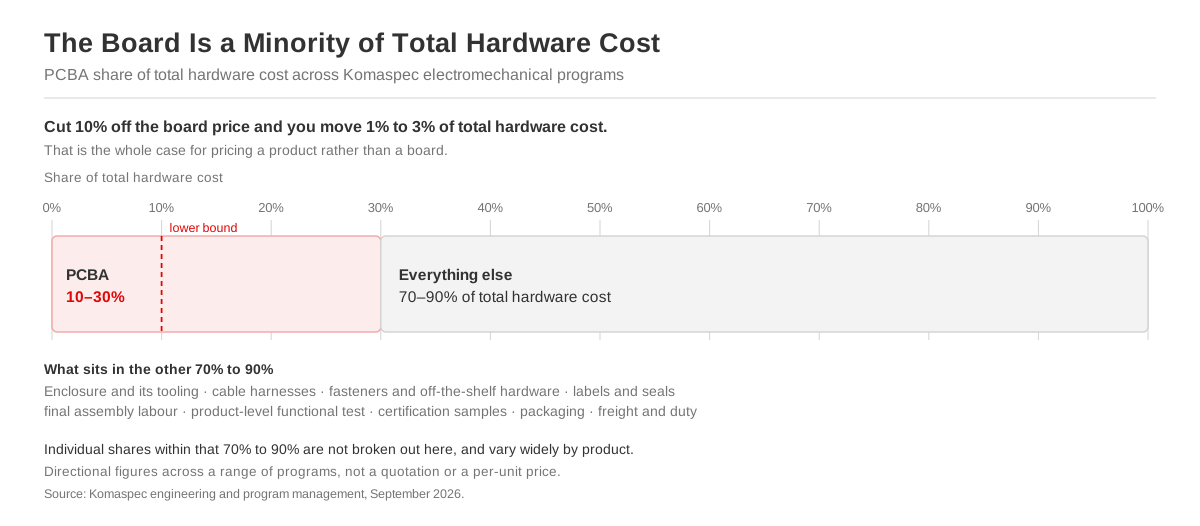
One number is worth having up front: on our electromechanical programs, the PCBA is only about 10 to 30% of total hardware cost. A cheap board price and a cheap product are not the same thing.
Key Takeaways
The per-unit cost of PCB assembly is mainly based on production volume, because the NRE and setup costs are amortized across the entire production run.
The number of unique parts in your board, not just the total number of placements, can drive up the price for each unit.
The test scope and acceptance class specified for your board affect the final cost, with more stringent requirements translating to higher pricing.
PCBA is only about 10 to 30% of the total hardware cost for electromechanical assemblies, so it’s one factor to consider among many.
Table of Contents
- Main Takeaways
- What Goes Into a Quote for PCB Assembly?
- The 9 Cost Drivers for PCB Assembly
- 1. Order Volume and NRE
- 2. Placement Count and Unique Part Count
- 3. Package Mix and Pitch
- 4. Through-holes and Hand-soldering
- 5. Bare Board Spec and Panel Utilization
- 6. Component Sourcing and Availability
- 7. Test Scope and Test Fixtures
- 8. IPC-A-610 Acceptance Class
- 9. Turn Time and Secondary Processes
- You Got Two Quotes for the Same BOM That Are Thousands Apart. Why?
- What Isn’t Included in a PCB Assembly Quote
- How to Compare PCB Assembly Quotes Fairly
- Get a Quote at the Right Level
- Frequently Asked Questions
What Goes Into a Quote for PCB Assembly?
Each quote will ultimately be a combination of the six elements listed below, along with costs for margin and overhead.
| Cost | What | How |
|---|---|---|
| Components | Every BOM line plus overage for attrition | Scales with quantity, with price breaks at reel and volume thresholds |
| Bare board | Fabrication to your stackup, plus fab tooling | Scales with panel count tooling is fixed per revision |
| Machine time | Stencil print, pick and place, reflow | Scales with placements; setup time is fixed per job |
| Manual labor | Through-hole, hand soldering, rework, visual inspection | Scales with content |
| Inspection and test | AOI, X-ray, electrical test, functional test | Fixturecycle time scales |
| Non-recurring engineering | Stencil, panel tooling, programming, test fixtures, first-article build | Fixed per revision, regardless of quantity |
| Overhead and margin | Facility, engineering, program management | Usually a percentage, sometimes a floor charge |
NRE will be fixed regardless of volume. If you’re ordering a dozen boards or thousands, it comes out the same. And for a prototype run, the NRE can even cost more than the boards themselves.
This can trip some people up, because some suppliers will leave it out of the unit price and invoice it later. Which means you could end up paying more than your quoted price.
Every PCBA quote will have these elements. The only difference is that some suppliers will list them all on the quote, while others will leave out some elements. If you don’t see one of these, it means the expense has been folded into the unit price or it’s a cost you’ll have to pay separately.
The 9 Cost Drivers for PCB Assembly
Here are the nine factors that make up the total cost of a PCB run, ranked by how much they influence the price.
1. Order Volume and NRE
Volume is the number one variable.
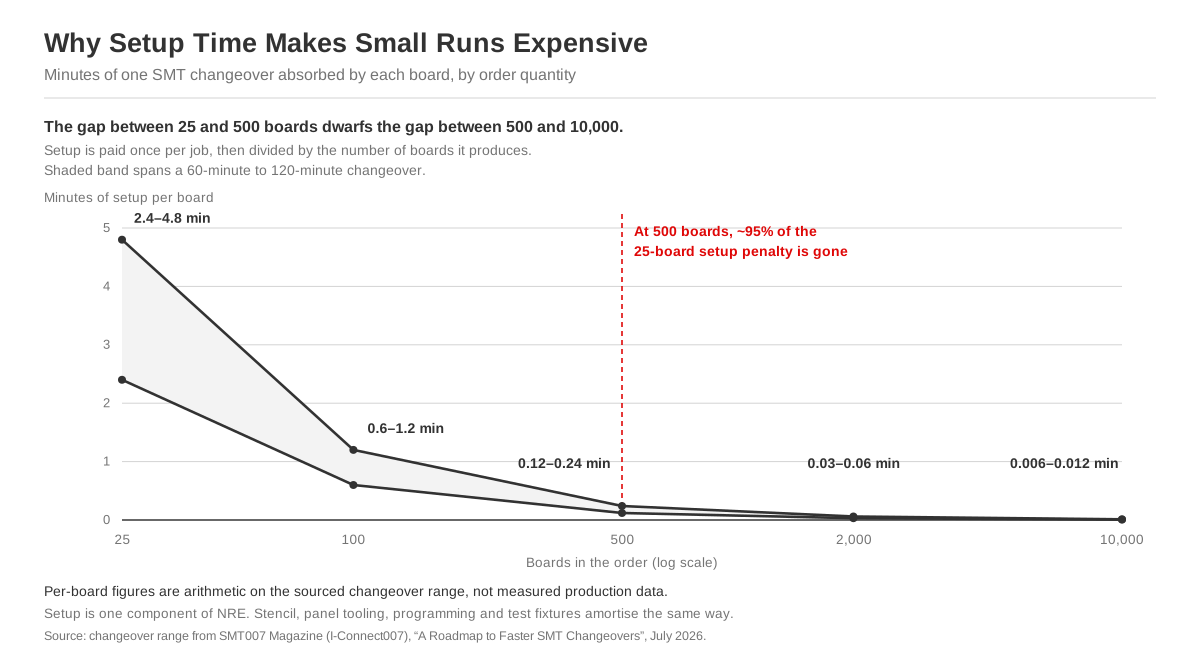
A high-mix SMT changeover involves changing the stencil, swapping feeders and reels, loading the placement program, and confirming the reflow profile. This doesn’t happen instantly, but will take about an hour or two for a new program. According to SMT007 Magazine, some top-tier EMS providers have shaved this time down to less than 10 minutes using SMED methods, but for every other supplier, it’s a time-intensive process.
The time spent on this changeover is a one-time expense that gets divided across your entire unit count. If you’re ordering 50 boards, a two-hour setup tacks on the equivalent cost for more than two minutes to each of your boards. If you’re ordering 5,000 boards, that setup time gets spread so thin that it rounds down to practically zero added cost to each unit.
This is why you should never compare per-unit prices quoted at different quantities. Instead, ask each supplier to give you pricing for the same three break points. That way, you’ll be able to compare apples to apples.
2. Placement Count and Unique Part Count
These two counts often get conflated but they represent very different expenses. The number of placements affects how much time it takes the machine to populate the board. But the number of unique parts affects how much labor will be needed for feeders, reel setups, purchase orders, incoming inspections, moisture-sensitive device handling, and kitting.
The two are not equivalent, so 50 placements doesn’t affect the unit price the same way that 50 unique parts would. Bumping up the unique part count will always cost more than increasing the number of placements. So building a board that has 400 placements drawn from 40 different part numbers is cheaper than building one with 200 placements drawn from 90 unique parts, even if the drawing looks simpler.
When possible, the cheapest way to reduce your overall cost is to consolidate part numbers (before the design is frozen). If you can bring the number of unique resistors down to three instead of nine, you’ll see real savings, even if you end up with the same number of resistors on the board.
A DFM review can help you catch this early. But once the BOM is released, the unique part count (and the cost of them) is locked in.
3. Package Mix and Pitch
BGA and QFN assemblies have hidden joints, which makes X-ray essential. Ultra-small passives need a bigger buffer, because tiny parts get lost more easily and tape-and-reel feeding needs long leaders. As such, Cofactr puts the overage for 0201 and 01005 chip components at 200+ parts, compared to only 100+ for 0402 chips or larger. With ICs and connectors, you can get away with far less – about 5 to 10%. If you’ve got a double-sided assembly, it will take two reflow passes, two stencils, and fixturing for the first side.
Some people try to save cost by downsizing the passives to 0201 so they take up less real estate on the board. And sure, you’ll save in laminate by doing that, but then lose it all in overage and placement yield. Unless you could genuinely benefit from clearing some board area, it’s probably not worth it.
4. Through-holes and Hand-soldering
Through-holes add labor time, not machine time. And labor costs can be relatively steep depending on the region.
On paper, you would think that 300 placements would cost more than a dozen connectors and transformers. But if those latter components are fitted by hand, the cost can easily outweigh them.
Using wave and selective soldering can knock down the cost a bit, but they also add their own setup and tooling costs. Below a certain volume, it’s not even worth programming them. But if you’re ordering a high-volume run for a design has a lot of through-hole content, ask about the cost of selective soldering. The tooling might be worth it once it’s broken down over enough units.
5. Bare Board Spec and Panel Utilization
6. Component Sourcing and Availability
In 2026, components are one of the most volatile costs in PCB assembly. Based on figures from IBS Market Intelligence, the distribution inventory across 15 component categories is 18% lower than it was in May 2025. Average lead times were 16.7 weeks in February 2026 and only a few months later jumped to 20.6 weeks. Semiconductor lead times are especially lagging, at 26.8 weeks.
These supply issues affect your quote in various ways. There might be broker premiums tacked on to your order for materials that couldn’t be sourced through authorized distribution. Expedite fees to help the project stay on schedule. Alternates could have you paying additional reel minimums (which are NCNR line items). Order buffer stock could tie up capital before the materials are even ready to ship out. Worst case scenario, you might end up having an expensive redesign because some critical component went end-of-life before the purchase order could be fulfilled.
Outside of the cost of the materials themselves, MOQs and compliance requirements can also tick up the price of sourcing everything on your BOM because they limit the number of acceptable vendors. That’s the first issue our sourcing team looks for so we can figure out the best way to get the necessary materials within those constraints.
7. Test Scope and Test Fixtures
PCB assembly testing methods range from simple visual checks to functional testing on the finish boards. Every test is an expense, but building the fixtures is the major cost center. For example, to run in-circuit testing, you’ll need a bed-of-nails fixture and a tester to drive it. The ICT equipment itself costs over $100,000 according to FixturFab, and the ICT fixtures themselves land in the tens of thousands. Thankfully, fixtures for functional testing are far more affordable — hundreds to low thousands — though they still tack on four weeks of lead time.
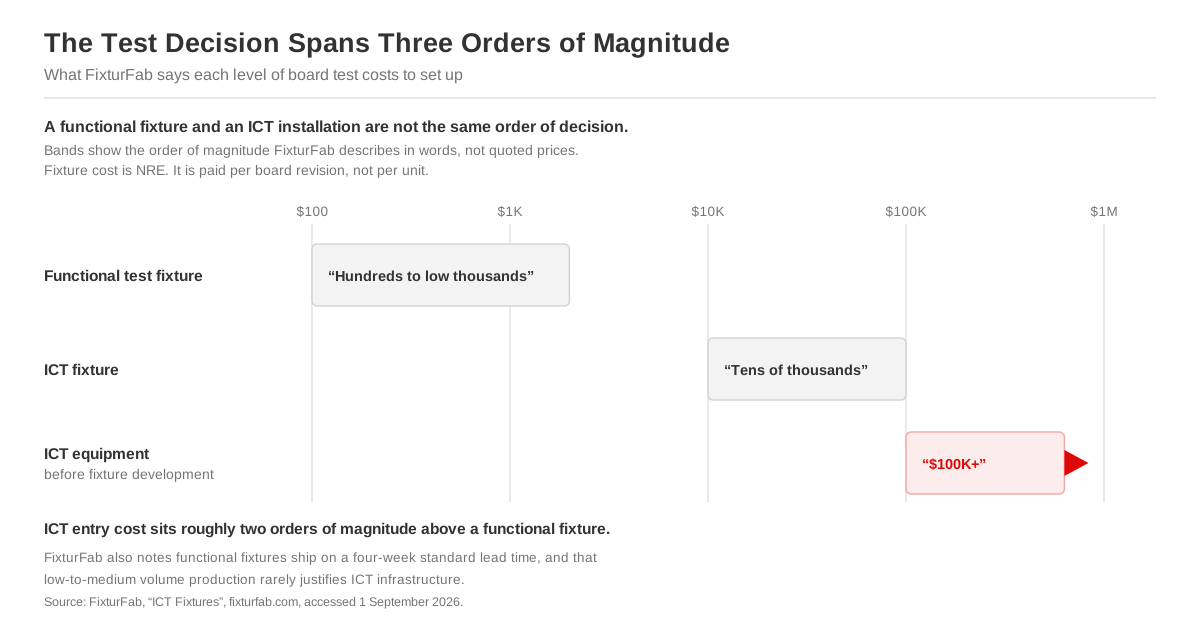
The good news is you don’t need to run ICT for most SMEs. As FixturFab notes, for low and medium volume orders, the cost is rarely justified. In those cases, functional fixtures are generally sufficient. You can also add AOI to catch solder and placement problems before the end of the production line. ICT becomes a worthwhile investment only when you’re producing at high volumes based on a stable design. For a more detailed rundown of each testing method and the defects they’re designed to catch, consult our guide to turnkey PCB assembly.
8. IPC-A-610 Acceptance Class
9. Turn Time and Secondary Processes
Quick turn PCB assembly will cost you more than a project with a standard timeline. To meet a five-day target, for example, the assembler might have to displace scheduled jobs to prioritize your order, use air freight to get components sourced in time, pay overtime to get the labor needed, and pay extra for expedited board fabrication.
Then there are secondary processes, which each add setup and operations to the assembly. These items (like conformal coating, depaneling, potting, serialization, cleaning, and labeling) aren’t always on the RFQ, and it’s easy to see why. None of these are big line items on their own, and the costs are small compared to, say, the testing fixtures. But when you add all of them up, they can absolutely move the needle.
You Got Two Quotes for the Same BOM That Are Thousands Apart. Why?
Usually, the difference in quotes has to do with four assumptions the supplier makes (unless you specify otherwise).
The assumed production volume. If you don’t specify volume, the suppliers will go with what they consider the default. For one supplier, that could be 5,000 units. For another, it might be 500. That can lead to two massively different quotes that are difficult to compare.
Non-recurring engineering costs. NRE includes one-off expenses like stencils, fixtures, panel tooling, and programming. These are part of every quote, but suppliers handle them differently. Some will include these costs (or some of them) as individual line items. Others might roll them into the unit price instead of including them separately. And certain suppliers will simply leave them off the quote but add them to your order.
How much testing will be involved. This is another one where suppliers deviate. One might quote you based on the assumption that your PCBs will go through AOI, X-ray, and a flying probe. Another might quote you based on AOI testing alone.
PCB acceptance class. Most assemblers will default to Class 2 if you don’t specify one. But that’s not always the case. Some will quote you based on Class 1. Others will assume you want high performance and give you the price for a Class 3 assembly.
It’s tempting to go with the cheapest PCB assembly quote you get. But that’s often a false economy. In many cases, it will either have to be adjusted up later when you have to tighten the acceptance class or lower the order volume, or the quote left off certain expenses that you’ll be billed for separately.
What Isn’t Included in a PCB Assembly Quote
For our electromechanical programs, the PCBA itself is only about 10 to 30% of the total hardware cost. So when you get a PCBA quote, remember that it only covers a portion of the total expenditure for your product, and that most of the cost lies outside of it.
| Outside the PCBA quote | Cost | Who handles it |
|---|---|---|
| Enclosure and its tooling | Tooling is fixed and substantial parts scale | Separate supplier separate lead time |
| Cable harnesses and connectors | Labor-heavy, low tooling | Separate supplier |
| Fasteners and off-the-shelf hardware | Low unit cost, high line count | Usually you |
| Labels, seals, gaskets, light guides | Cheap parts, artwork and approval effort | Usually you |
| Final assembly labor | Scales with unit count and complexity | Separate supplier or in-house |
| Product-level functional test | Fixture NRE plus cycle time | Frequently unowned until late |
| Certification samples and lab fees | Fixed per certification and per product | You |
| Packaging design, materials, drop testing | Design NRE plus per-unit materials | Usually you |
| Freight, duty and customs | Percentage of landed value, set by origin | You, unless one supplier ships the finished product |
| Coordinating the suppliers above | Unbudgeted staff time | Always you |
This is why you should never look at PCBA quotes in isolation. Because a cheap run for the boards could still result in an expensive product. In the end, you’re dealing with multiple suppliers that each bring their own lead times, pricing, documentation, and potential problems or delays to the project.
In our experience, there are two things that customers often fail to budget. One is the testing and associated expenses. The other is material yield loss. Both of these are often not explicitly listed on the quote.
And then there’s the work involved in coordinating multiple vendors and resolving issues that arise between their ends of the project. That is harder to quantify, but it can be a substantial cost that comes in the form of extra hours of work for your engineers.
The certification costs are much more transparent. You’re the one responsible for those, and you can check out our comparison of UL, ETL and CSA certification to see what’s involved.
Another consideration is where the PCBs will be assembled. That often changes the landed cost even if it doesn’t have a big effect on the unit cost. The United States Trade Representative (USTR) has announced that Section 301 exclusions listed under HTSUS heading 9903.88.69 currently apply only to goods entered before 11:59 p.m. on 9 November 2026. The USTR may consider further extensions, but none are official at the time of writing. But the point here is that rates and exclusions are always subject to change, and your product’s origin is fact-specific. Make sure you confirm your own HTS lines with a customs broker, not your supplier.
Some costly issues can be avoided by working with a partner that offers full box builds. Komaspec doesn’t sell standalone turnkey PCB assembly. Instead, we work with assembly suppliers as part of our box build program, which also handles enclosures, harnesses, and final assembly, along with the program management needed to keep every project smooth and streamlined. We also run the testing in-house, using functional test jigs and go/no-go gauges that we develop on site. This means we test every board directly against the product it’s built for.
Unlike assemblers, we handle the build until the end when it’s ready to be delivered to you. We test every unit in line, label and package them to your specifications, and then ship them out (either as an export consignment or into your 3PL). You’ll get one quote that covers the entire build run. And because we have facilities based in Guangzhou and Haiphong, we can quote the same product based on two different duty and transit profiles so you can compare them and make the smart decision before the design is locked in.
How to Compare PCB Assembly Quotes Fairly
- Normalize your order quantity. Give each supplier the same three break points, including the quantity you plan to actually order. That way, you can compare prices based on the exact same volume.
- Separate NRE lines from the unit price. Ask to have the one-time engineering costs itemized. Then you can rebuild the total cost yourself.
- Compare the actual test scope. Instead of just looking at whether the assembly will be tested at all, specify the testing methods for your product and ask which are included at each of your listed quantities.
- Specify the acceptance class. That way, you avoid unknowingly comparing a quote for Class 1 assembly with one for Class 3.
- Check overage rules and who owns residual material. This can influence the final price, so get clarity on the overage by package size, your NCNR exposure, and what happens to leftover materials after your order is complete.
- Price the other parts of the build before comparing PCB assembly pricing. Make sure you get a good sense for how much the enclosure, harnesses, and final assembly will cost you. Having an approximate idea of this will help you see the total cost of your product and how the PCBA quote fits into it.
- Check and understand the validity period. Ask each supplier how long the quoted price holds and which situations will trigger a re-quote.
(Note that this is specifically for evaluating quotes. For advice on the RFQ itself, use the nine-point checklist in our turnkey assembly article).
We included that last point because our program managers say this is the line item that causes the most disputes. Which makes sense, because it’s frustrating and disruptive to have a price change while you’re still in the middle of making a decision.
The second thing they said leads to disputes? Ambiguous or incomplete drawings or BOM files. That one falls on you, and so do the consequences. Because if an assembler gives you a quote based on incomplete information, that price could change significantly once they get all the details. And this might happen after you’ve already committed.
In the end, when you have two suppliers giving you two different quotes, it often comes down to one of the seven things listed above – or how badly one of them needs the work.
Get a Quote at the Right Level
If you’re pricing a board, any assembler can give you a number. If you’re pricing a product, ask for the enclosure, harness, final assembly, test and packing in the same quote, so the comparison covers the build that actually ships. Send us your BOM and drawings and our engineering team will come back with a DFM review and a quote that itemizes NRE, test scope and sourcing model. Request a quote.
Frequently Asked Questions
How much does PCB assembly cost per board?
The price of boards depends mainly on the quantity ordered. The one-time costs like setup, tooling, and test fixtures are fixed for the entire production run and rolled into the unit price. Because of that, a prototype run of 25 boards can have a higher unit price than a 5,000 unit run.
What does PCB assembly cost per component?
Assemblers don’t price a job based on component or placement. The more important factor is the number of unique parts, package mix, and the board’s through-hole content. The math isn’t as straightforward as some people assume, which is why a board with 40 part numbers and 400 placements will cost less than building one with 90 unique parts spread across 200 placements.
Why is prototype PCB assembly so expensive?
It’s mainly because of non-recurring engineering (NRE). These costs are the same no matter how many units you order, so they get divided for each unit. So the price of test fixtures, stencils, and programming is noticeable on each unit of a 20 board run, but shrinks to almost nothing when you’re ordering thousands of PCBs. Component overage to cover attrition also adds about 10 to 20% to the part cost for a prototype order.
Does low cost PCB assembly mean lower quality?
Not always, though a cheaper quote usually results from a lower acceptance class, less stringent inspection methods, or components sourced from the grey market or brokers (rather than through authorized distribution). In some cases, it could also be that the supplier is leaving out certain line items and pricing them separately, so make sure to ask what’s excluded from a cheaper quote before dismissing it out of hand.
What share of total product cost is the PCBA?
For Komaspec’s electromechanical programs, PCB assembly accounts for about 10% to 30% of the total hardware cost. The majority of the cost covers other aspects of a box build, like enclosure tooling, harnesses, fasteners, assembly, and product testing. To get a better idea of how the costs stack up, build your budget starting from the full product rather than the board.
What should a full turnkey PCB assembly cost estimate include?
Components (including any overage), bare board fabrication, SMT and through-hole processing, inspection and testing, and NRE broken out into individual line items. It should also state the assumed volume, the acceptance class, and the sourcing channel. Ask about anything that’s left blank so you get full transparency about the quoted price.