
Overmolding Materials: Substrate and Resin Compatibility
- Key Takeaways
- What Materials Are Used in Overmolding?
- Overmolding Material Compatibility Table
- How Does Overmolding Adhesion Work?
- Difficult Overmolding Substrates
- How Do You Test Overmolding Adhesion?
- Why Do Compatible Overmolding Materials Fail?
- Overmolding Failure Table
- FAQ
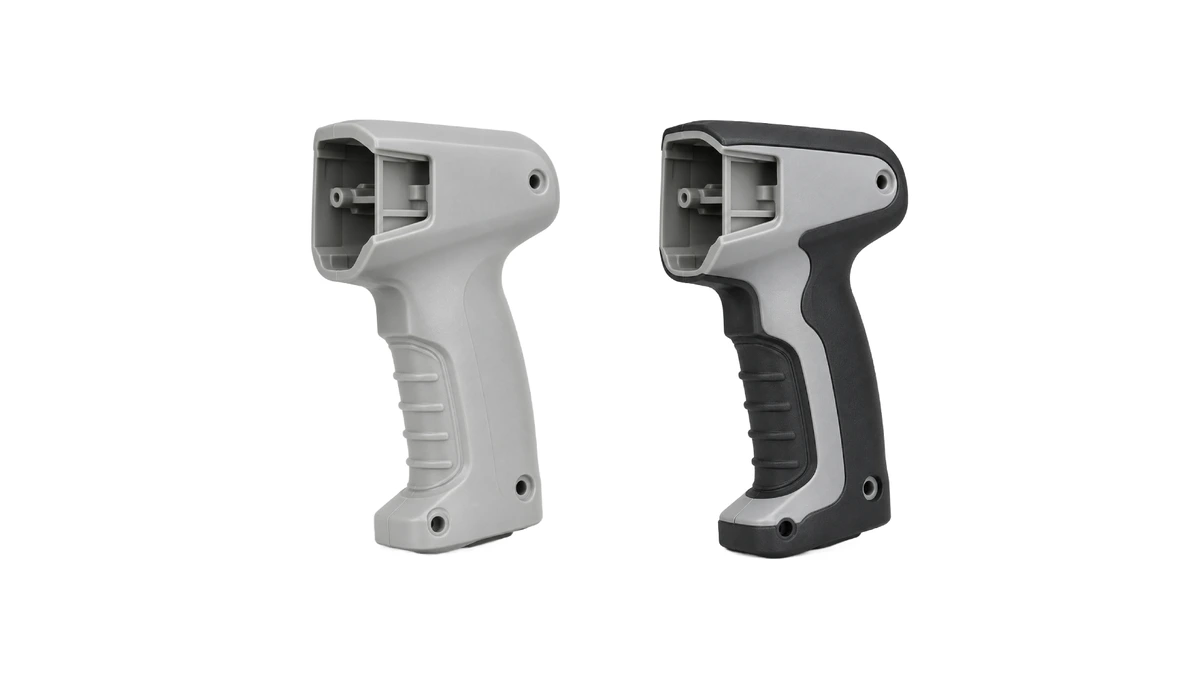
Overmolding creates a bond between a rigid substrate (usually PP, ABS, PC, or nylon) and a soft overmold resin (usually TPE, TPU, TPV, or liquid silicone rubber) molded over it. For these materials to hold, they need to be chemically compatible.
Polymers bond to polymers that resemble them. For example, a standard SEBS-based TPE will grip firmly to polypropylene, but will fall off a polycarbonate substrate.
So how can you pick the right materials?
This guide shows which overmolding materials bond to which substrates, explains why they're compatible, and goes over alternatives in case you need to bond incompatible materials.
Before we start, there's one thing you should know. Compatibility is grade-specific. So even when two polymers should bond, whether they do (and how well) will depend on their specific formulation.
So while the information here will be useful to create a shortlist, your final decision should be based on the supplier's bonding-grade datasheet and a peel test on your prototype parts.
Key Takeaways
Overmolding relies on a chemical adhesion created between the rigid substrate and the softer material applied to that substrate's surface.
The strength of the bond depends on the chemical compatibility between the materials.
SEBS-based TPEs are the most common overmolding materials because they're affordable and can be formulated to bond to specific substrates.
Incompatible materials create a weak bond that is at higher risk of peeling or delamination.
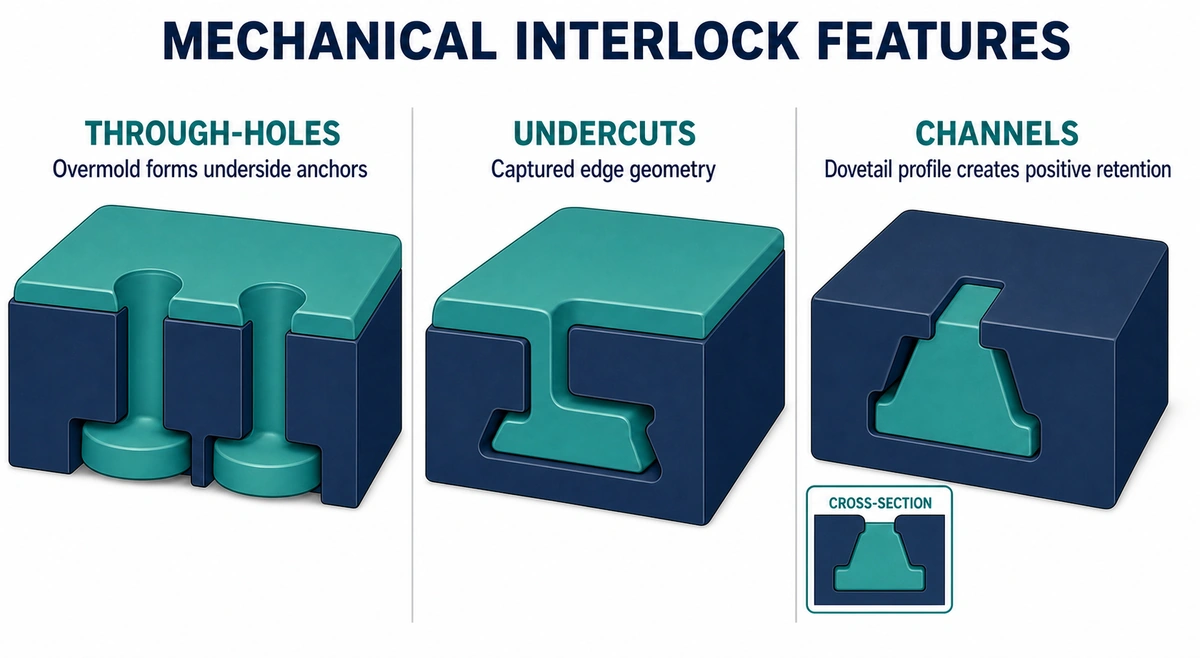
Interlocking mechanical features in an overmolded part can help compensate for a weak chemical bond.
Table of Contents
- Key Takeaways
- What Materials Are Used in Overmolding?
- Overmolding Material Compatibility Table
- How Does Overmolding Adhesion Work?
- Difficult Overmolding Substrates
- How Do You Test Overmolding Adhesion?
- Why Do Compatible Overmolding Materials Fail?
- Overmolding Failure Table
- Frequently Asked Questions
What Materials Are Used in Overmolding?
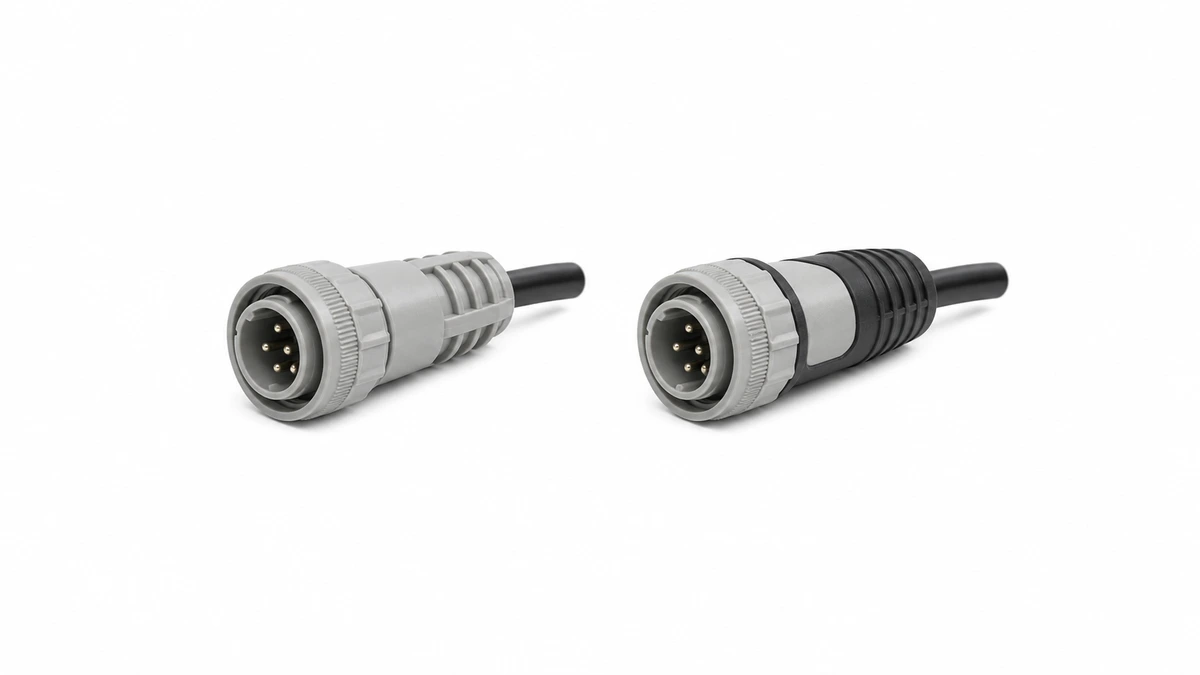
Overmold Materials
Almost every overmolding material falls under one of four categories:
- SEBS-based TPEs: These are the most common because they're cheap, easy to process, and available in grades formulated for specific substrates.
- TPU: This creates a soft layer with higher resistance to abrasion and tearing.
- TPV: This is a PP/EPDM alloy that is able to handle higher temperatures and compression set. It's mainly used in automotive sealing.
- TPO is a lower-cost alternative to TPV that works on the same substrates but has less elasticity.
- Liquid Silicone Rubber (LSR): This material offers heat resistance, biocompatibility, and properties TPEs can't match.
Substrate Materials
For the substrate, the common materials are polypropylene (PP), ABS, polycarbonate (PC), PC/ABS blends, nylon (PA6/PA66), and PBT.
Which substrate you choose will depend on the part's structural requirements (stiffness, temperature, cost). But you should also consider how well it works with the overmolding material you'll be using. Otherwise, you may not get the kind of reliable bond that ensures your product is durable.
For more advice on selecting the right substrate, check out our plastic injection materials page.
Overmolding Material Compatibility Table
| Substrate | SEBS TPE | TPU | TPV | LSR |
|---|---|---|---|---|
| PP | Excellent (standard grades) | Poor; use interlocks | Excellent | Specialty grades only |
| PE | Good (PE-bonding grades) | Poor | Good | Poor (use interlocks) |
| ABS | Specialty grades | Excellent | Mechanical only | Limited |
| PC | Specialty grades | Excellent | Mechanical only | Good (self-bonding grades) |
| PC/ABS | Specialty grades | Excellent | Mechanical only | Limited (specialty grades or surface treatment) |
| PA6 / PA66 | Specialty amide-compatible grades | Good | Mechanical only | Good |
| PBT | Specialty grades | Good | Mechanical only | Good |
| POM (acetal) | Mechanical only | Mechanical only | Mechanical only | Mechanical only |
Note: This information is compiled from documentation from Avient/GLS and Teknor Apex.
The information in this chart may not be sufficient for making your final decision. Confirm the specific grade against your supplier's bonding data.
There are two patterns worth noting. Nonpolar overmolds bond to nonpolar substrates: SEBS and TPV (both olefinic) work well with PP but not the polar engineering resins. And polar bonds to polar: TPU adheres well to ABS, PC, and nylon but poorly to PP.
If a supplier claims they have a "universal" grade, that means there's a formulation compromise. These "universal" materials will bond to a wider range of substrates, but usually with lower peel strength than a dedicated grade would deliver.
How Does Overmolding Adhesion Work?
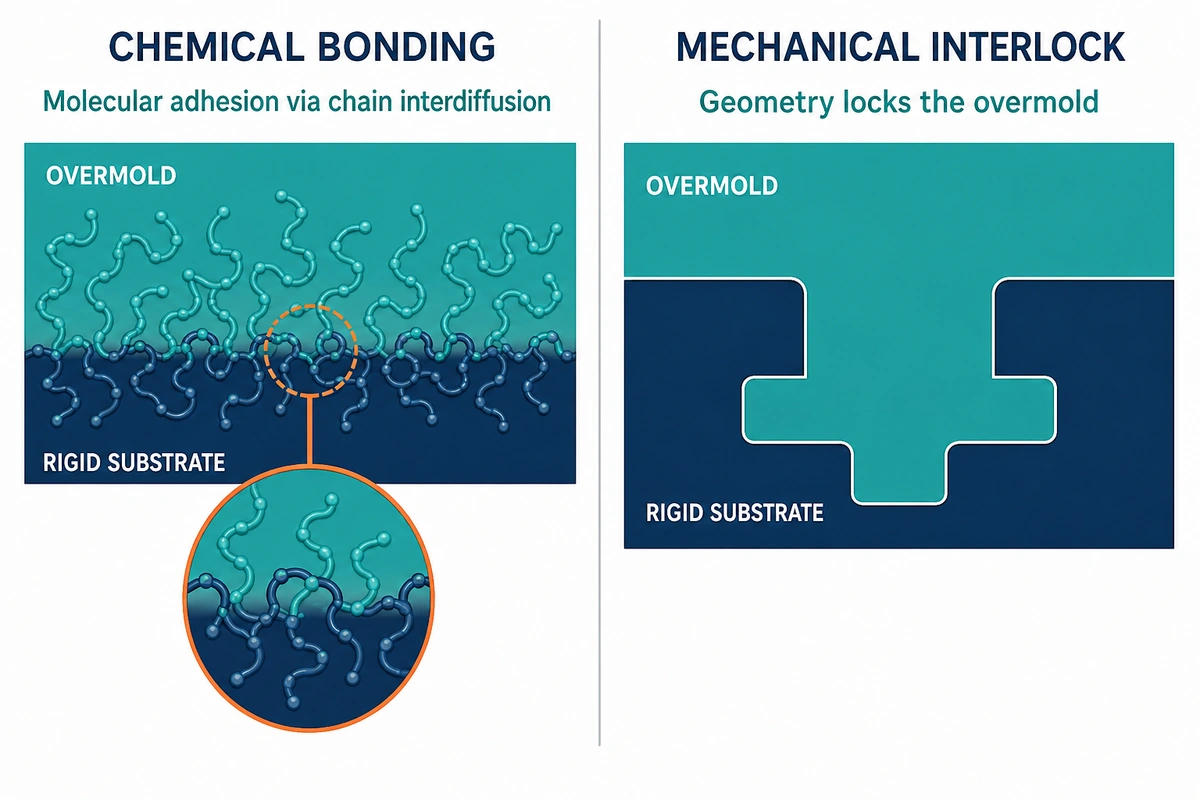
Chemical Bonding
Chemical bonding happens at the melt interface. The overmold shot arrives hot enough to soften the surface of the substrate surface. If the two polymers are chemically similar, their chains interdiffuse and entangle across the boundary, creating a hold.
Heat also plays an important role in this process. The overmold has to arrive hot enough to soften the substrate surface and stay fluid enough to spread into full contact with it — a condition called "wet-out." Without wet-out, the chains can't entangle and the bond won't form. That's why running the melt too cold starves the interface. But hotter isn't automatically better: past the material's processing window, excess heat degrades the polymer instead of strengthening the bond.
Mechanical Interlocking
Difficult Overmolding Substrates
Some substrates are more challenging to overmold than others. Here are four cases where adhesion may be difficult.
Nylon
Nylon is bondable but unforgiving. Standard SEBS grades won't adhere to it. Instead, you need amide-compatible formulations developed specifically for PA6/PA66.
Glass-filled nylons are even more difficult. Fibers at the surface of the material reduce the bondable polymer area, so peel strength drops even if you're using the right grade. If your design involves overmolding on filled nylon, spec interlocks to create a strong mechanical bond.
POM (Acetal)
Almost nothing bonds to POM because of its low surface energy and chemical resistance. Design for mechanical retention from the start whenever using a POM substrate.
What about surface treatments? It's true that plasma or corona treatment and primer systems can raise the surface energy of PP, PE, or POM enough to allow a bond to form. But they add a per-part processing step with its own drift and inspection burden. Because of that, it's usually best to rely on a bonding-grade overmold or a mechanical interlock designed into the tool. Reserve surface treatments for cases where neither of these solutions are available.
Metal
Molten thermoplastic doesn't chemically bond to metal, so all the retention needs to come from mechanical features (like knurled or textured surfaces). If you're overmolding LSR onto metal, primers and self-bonding grades can work.
If you're molding plastic over a machined or stamped metal component, that's not technically overmolding. It's insert molding, and it comes with its own methods for holding components in place.
Overmolding LSR onto Thermoplastics
With LSR on thermoplastics, the real challenge is heat, not chemistry. LSR cures in a heated tool, so the substrate has to hold its shape at cure temperature. This limits your choice of substrate to PA, PBT, PC, and other high-heat-deflection resins.
Plastics Technology covers the do's and don'ts for these materials. Self-bonding LSR grades have largely replaced primer systems, but substrate heat resistance remains the main consideration.
How Do You Test Overmolding Adhesion?
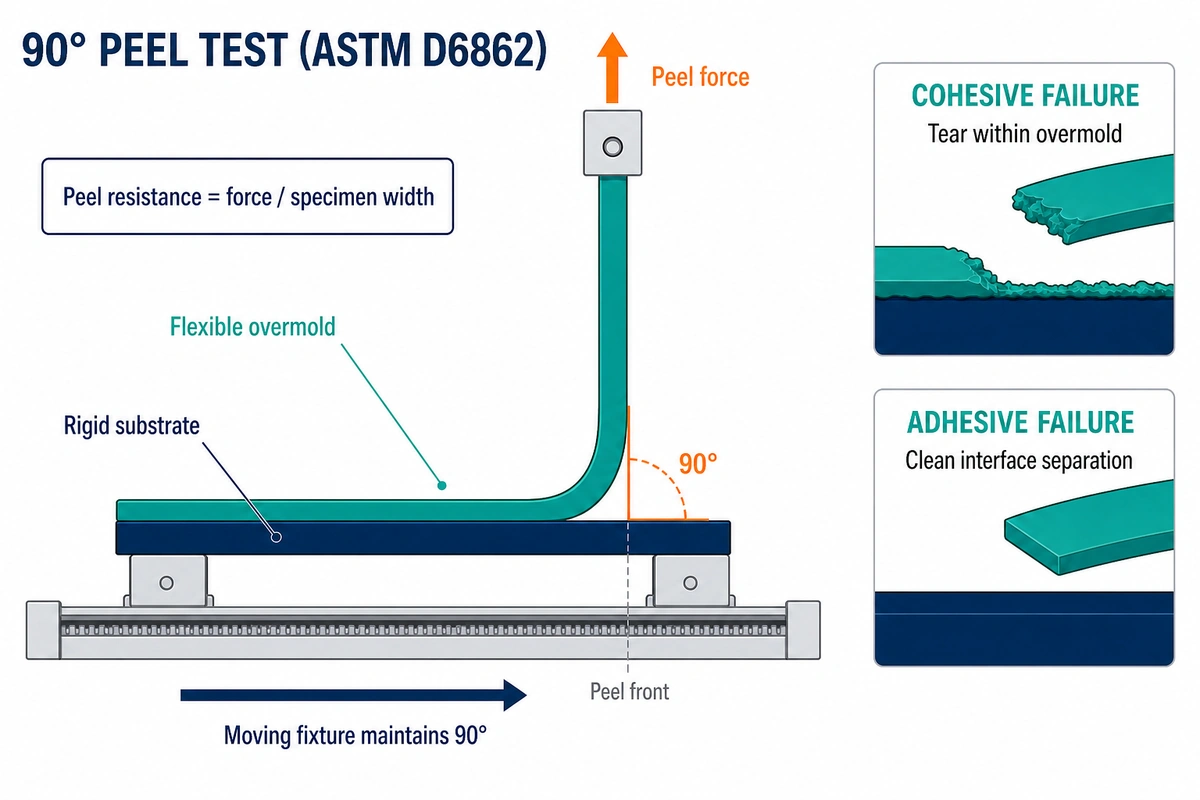
Peel testing is the primary method. ASTM D6862 covers the 90° peel resistance test, which pulls the flexible overmold off the rigid substrate at a right angle and reports the force per unit width needed to separate them.
Suppliers publish peel values for their bonding grades on standard substrates. Those numbers are useful for ranking candidate grades but they're not a substitute for testing your own prototype. Actual peel resistance will also depend on overmold thickness and how the overmolding process is handled.
Why Do Compatible Overmolding Materials Fail?
Compatible materials can still delaminate if they're processed in a way that introduces contaminants at the interface or cools the surface.
Usually, this is caused by one of the following issues:
- The substrate has absorbed too much moisture (this is especially common with nylons).
- Mold release or oils are left on the surface of the substrate when the overmolding is applied.
- Melt temperatures are too low to soften the substrate surface.
- For insert-style two-step overmolding, a substrate that sits too long between molding and overmolding can cool and pick up contaminants.
- Gates and runners cause heat to be lost at the far end of the flow path.
Even compatible materials can fail due to poor drying, handling, or thermal management. Verify your injection molding supplier's processes to make sure they have suitable controls in place.
Overmolding Failure Table
| Symptom | Likely cause | Fix |
|---|---|---|
| Overmold beads or pulls back from areas of the substrate | Contaminated surface, or surface energy too low for wet-out | Clean substrate handling; check grade-to-substrate match |
| Bond fine at ejection but delaminates in service | Marginal chemical bond with no mechanical backup | Add interlocks; retest with environmental conditioning |
| Weak bond at the far end of the flow path | Melt temperature lost before the interface wetted | Redesign gate/runner to preserve melt temperature |
| Voids or blisters at the interface (nylon substrates) | Substrate moisture flashing to steam | Dry the substrate to the resin supplier's spec before the overmold shot |
Choosing an overmold grade, or troubleshooting a bond that isn't holding? Request a quote or a DFM review and Komaspec's engineering team will assess material pairing, interlock design, and process controls for your part.
Frequently Asked Questions
What is the best material for overmolding?
The best overmolding material is one that is chemically compatible with the substrate. For PP substrates, a PP-bonding SEBS TPE is the default choice because of its low cost, easy processing, and strong bond. For ABS or PC, opt for TPU or a PC-bonding TPE grade. For high-heat or biocompatible applications, use LSR.
Does TPE bond to nylon?
Standard TPE grades don't bond to nylon. Bonding to PA6 or PA66 requires specialty amide-compatible TPE formulations, and glass-filled nylons reduce peel strength because of fibers on the bonding surface. For filled nylons, combine a nylon-bonding grade overmold with mechanical interlocks rather than relying on adhesion alone.
Can you overmold silicone onto plastic?
Yes. LSR overmolding onto thermoplastics is an established practice, using self-bonding LSR grades. But heat is an important consideration. LSR cures in a heated mold, so the substrate needs high heat-deflection resistance. PA, PBT, and PC can work, but low-heat substrates like PE generally don't survive the cure temperature.
What's the difference between TPE and TPU for overmolding?
TPU is tougher than TPE. It has better abrasion, tear, and chemical resistance. It also bonds to polar substrates like ABS, PC, and nylon. SEBS TPEs are cheaper, softer at the low end of the hardness range, and bond well to PP. So TPU is more expensive, but may be worth the added cost if the soft layer will be exposed to a lot of wear.
Why is my overmold peeling off?
In most cases, it's because the substrate and the overmolding material are chemically mismatched (the TPE was not formulated for that substrate). Peeling could also be the result of an overmolding process that failed to create the right conditions at the interface (wet substrate, contaminated surface, or melt temperature too low). A design with no mechanical interlocks is also more susceptible to peeling since it relies entirely on the strength of the chemical bond. A 90° peel test with failure-mode inspection will help you identify the real source of the problem.